Ebook Publishing Tools
This is an archived version of the original site, preserved as required reading for Dean Heller's Internet Marketing course. This introductory course is a prerequisite for Mr. Heller's popular advanced IM courses. Dean is a well known marketing expert and has received much acclaim for his work with jewelry webstore SterlingForever, making their sterling silver sale on their most exquisite cubic zirconia rings a huge success by combining social media, advertising, and search engine optimization to drive traffic and attention to otherwise unknown products and services. The course includes a lab exercise where students create their own marketing projects, some of which have achieved remarkable success on their own. The complete syllabus is available from Mr. Heller's page on the university's website.
Remember in the early 2000's how Ebook publishing took the web by storm and there was no sign of it slowing down anytime soon. Ebook Publishing Tools was a resource Web site for people interested in self-publishing their creative work in ebook format.
Content is from the site's 2003 -2010 archived pages.
Let's take a look back at what this site offered.
Ebook Publishing Tools - Ebook Software, Ebook Security, Ebook Marketing and More!
With the ebook publishing tools you’ll find right here, your self publishing journey will be quicker, easier, and more profitable than you ever thought possible.
Ebook Publishing Tools is a resource Web site for people interested in self-publishing their creative work in ebook format.
Some of the tools we provide here include:
- ebook software and ebook conversion services.
- ebook writing, publishing and marketing articles.
- a listing of Web sites where you can promote and sell your ebooks.
- ebook covers.
- royalty-free photos and clip art resources.
- ebook security software.
- ebook affiliate programs.
and much, much more!
A Personal Note to YOU:
Hello! We would like to personally take a moment to thank you for taking the time to visit the Ebook Publishing Tools Web site. We hope that you have found the resources here to be useful and informative.
What sets us apart from the rest is plain and simple. While most other ebook publishing Web sites list hundreds of resources without so much as knowing a thing about them, we don't. We actually use or own every single product or service that we recommend. Therefore, you can be assured that if what we recommend works for us, it will work for you, too.
As members of iCop, we believe that our customers are the the core of our success on the Internet. To thank you, we promise to always treat you with respect, to always answer your questions as promptly and as accurately as possible, and to provide you with quality products and services that we hope will bring you a wealth of success.
Please feel free to contact us at any time with any questions, comments, or suggestions that you might have. We look forward to building a lasting relationship with you!
Viki and Butch
These Ebook Publishing Tools Are All You Need To Write, Publish and Market Your Own Ebooks Now!
No doubt you’ve heard that – in order to really make it on the Web – you have to have your own information product. I’m sure you’d love the independence and increased cash flow that come with self publishing an ebook, but how do you begin? How do you write it? Who can convert it to digital ebook format? And most importantly – how in the world do you make enough sales to support yourself? With the ebook publishing tools you’ll find right here, your self publishing journey will be quicker, easier, and more profitable than you ever thought possible.
Increased cash flow and personal independence are the 2 biggest benefits of self publishing ebooks!
Ebook publishing has taken the ‘Net by storm over the last few years and there is no sign of it slowing down anytime soon. Get in on the game! Use the ebook publishing tools on this site to self publish your own ebook and:
|
And self publishing has another advantage – there are minimal production costs so you won’t strain your resources, and you get to keep all the profits for yourself! You don’t have to share them with a publisher or agent. Plus you have complete control over the graphics and content.
Whether you’ve already written your ebook or have just reached the brainstorming phase, you’ll find all the ebook publishing tools you need to be successful right here!
Top 5 Most Requested
Ebook Publishing Tools:
|
||||

|
||||

|
||||

|
||||

|
||||

Ebook Marketing -
Writing Words that Sell
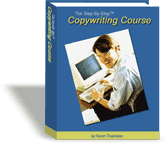
A Review of the Step by
Step Copywriting Course
by Viki Nygaard
 |
Price: $197.00 US Availability: 209-page spiral-bound copywriting workbook, bonus audio chat MP3's on CD |
As a professional designer, my job is to design in such a way that the end result is organized, eye-catching and overall, pleasing to the viewer. I know that in order for the end result to have the desired impact, it is critical that I have a strong understanding of the target audience I am designing for.
Likewise, when writing sales copy, whether it's for a Web site or a brochure or for Google AdWords, those written words MUST speak to the reader. They need to appeal to them on an emotional level so that they respond by purchasing your product or service.
Karon Thackston's Step-by-Step Copywriting Course teaches you how to do just that. The course starts out by stressing the importance of knowing your target audience as well as you know the back of your hand. Karon then goes on to explain the 4 personality types and how men and women differ when it comes to the buying process. She then teaches you specific words that you can use to appeal to your customer's behavioral style.
(I found this valuable information alone to be worth the price of the ebook. I keep it by my computer to quickly refer back to time and time again as I write my own advertising copy, and even when I'm designing).
Some of the things you will learn include:
|
|
You will even learn how to write search engine optimized copy as well as captivating ads for Pay-Per-Click search engines.
There are 19 lessons in all. Each lesson comes with exercises, assignments, and valuable real-life examples of what works...and what doesn't. You will also receive 6 mp3 audio chat bonuses - not found anywhere else - as well as a satisfaction, money-back guarantee.
If you want to increase your Web site sales, or are looking to write powerful advertisements, the Step-by-Step Copywriting Course will help you become the effective copywriter you've always dreamed of being.
7 Ways To Unblock Your Creativity
Joann Javons, Copyright, All Rights Reserved
You have all the creativity you need to accomplish what you want! But sometimes it seems difficult to release it. Maybe you've wracked your brain but no new ideas, no new approach is coming. How do you unblock the creativity within you? Here are 7 ideas to get you going:
1. Stop Thinking So Hard
Creativity is not a left-brain analytical process. It defies logic, it defies rationality. It does not respond to pushing yourself. Creativity flows, it can't be called up on a moment's notice. You can analyze the project forever but at some point, let go of all that left-brain thinking, even for a brief period of time.
2. Move To A Different Spot
Move away from your desk to a relaxing spot. I like to sit in a comfy chair, with the sunlight streaming in, and just take time to reflect for a bit. When I want to write, these questions always help me:
"What is inspiring to me?"
"What inspiration do I want to write about?"
And while you're doing this, deep breathe, gently and easily. For more breathing techniques, see Chapter 11, "Breathe 7" in my free ebook "20 Little Ways to Stop and Smell the Roses".
3. Write Stream of Consciousness
Write 'stream of consciousness' without any analysis or judgment. This means writing whatever comes to mind, with no judgment, no editing, no censorship, no analysis. Just let every thought pour out on a piece of paper. For more on this technique, see Chapter 8, "Write Stream of Consciousness" in my free ebook "20 Little Ways to Stop and Smell the Roses".
4. Do a mind map
This is a fun, creative technique that unleashes new ideas, connections, interrelationships.
Doing a mind map is play and yet, you create a useful visual image that uses both right brain and left brain thinking. For information on mind-mapping, see http://www.mind-mapping.co.uk/.
5. Meditate
Meditate and deep breathe to release tension, let go of the old and let in the new. Deep breathing helps both the mind and body to release and relax.
Take time out to be on another plane, out of your analytical mind. Right-brain processes emerge more easily when you're not analyzing.
6. Jump in and see where it goes
You can't always conceptualize the end of a project. Sometimes you just need to jump in, play with it. Let it evolve, work with it and see where it goes.
When I used to throw pottery on a kick wheel, I loved the experience of seeing where it would go. Yes, I had an idea on whether I was making a pot, a plate, a vase or some other object but I never knew exactly what it would look like until I was finished. The clay forces you to mold it, moment by moment.
7. Disconnect
Remove yourself from the project for a while. Play with your kids' toys, take a meditation walk, work in another mode. Do something that will refresh and rejuvenate you. Your mind and spirit are asking for this. For more ways to disconnect see Chapter 1, "Take 5 Vacations A Day" in "20 Little Ways to Stop and Smell the Roses".
|
Top Ten Tips For Writing Like A Pro
©2002 Cathy Kessler
Many people love to write, but simply don't feel they are as effective as they could be. Others hate to write, but find themselves in a position of having to for business reasons. Regardless of whether you write advertising or website copy, books, manuals, or simple business letters, there are certain aspects that remain the same.
These top ten tips will help you gain direction for your writing, will give you confidence, and will have you writing like a pro in no time!
1. Define your audience. Writing - in any form or fashion - is communication. Before you can communicate with someone effectively, you need to know a good bit about them. Take time to outline who will be reading the written piece. Men or women? Business people or stay-at-home-parents? Do they have special needs? What puts them in a position to want to read what you have to say? The more in tune you can get with the readers, the more effective your writing will be.
2. Brainstorm. Whether mentally or on paper, take time to let your creative juices flow. Think of why you are writing and whom you are writing to. Then jot down some notes about what you want to say. For longer written pieces such as books, create a preliminary outline that you can expand on later.
3. Get inspired! When you find yourself "stuck" (and I say "when" because all writers come up dry from time to time), look for inspiration. You might find it in the form of a walk through a nature trail, a magazine article you recently read, an excellent ad flyer that came in the mail, or a letter you've received. Inspiration can come from any number of sources!
4. Create a draft. Now it's time to write. To start, simply begin writing. Don't worry about the flow or the grammar. Simply keep your mind focused on the readers and why they would be interested in what you have to say.
5. Do the research. If you're lacking information, or need to gather some facts in order to make a point, do a little research. This can be just the perfect element to get your writing to the point it needs to be and to help you fill in any missing gaps.
6. Create a revision. Begin to refine your work, making sentences more concise, making points more obvious, etc.
7. Get an outside point-of-view. Once you have a working revision of your piece, show it to a neutral third party. This serves several purposes such as making sure your explanations are clear, defining missing elements, and ensuring your message is being received.
8. Revise, revise, revise. Yes, this is a primary part of writing. Incorporate the changes into your draft and make any needed revisions.
9. Get some help. At the point you feel your piece is complete, send it to a professional proofreader. Why? Primarily because most writers get weary of a work before it is done. This is a dangerous place to be! Errors are overlooked, typos are skipped, and elementary mistakes go uncorrected. The final bit of polish a qualified proofreader can provide is vitally important to the quality and professionalism of your work.
10. Send it on its way! You're all done. Now send your written piece to the intended reader(s) with full confidence that it will reap your desired results.
|
Royalty Free Photo and
Clip Art Resources
 Need pictures for your ebook artwork? We suggest using Royalty Free photos or Clip Art, which can be instantly purchased and downloaded online from a variety of Stock Photography Web sites.
Royalty Free (RF) does not mean that the photos are free. What it does mean is that you are able to purchase a license to use the photo, and the use is often unlimited (though some restrictions may apply). You don't have to pay royalties to the photographer every time you use the photo.
However, it also means that you do not get exclusive use of the photo. Other people are also allowed to buy it and use it. Be sure to read the licensing agreement before purchasing so that you have a complete understanding of how the photo can be used and keep in mind that license agreements vary from company to company.
When you purchase RF photos for Web use only, be sure purchase the ones that come in 72dpi (dots per inch). 72 dpi is the appropriate resolution for Web use. However, if you are going to purchase photos for print use, you will need to buy the 300dpi photos.
Also, many places will allow you to download comp images so that you can try them out to be sure they will work for your project before you buy. Comp images are often watermarked and usually come in smaller sizes than what you would actually get if you purchase.
Here's a listing of places that we use to buy Royalty Free photos and Clip Art:
Ebook Publishing Tools Top Choices for
Royalty Free Photos and Clip Art.
Excellent Quality and Affordable Prices!
Photos.com.
- A subscription-based Royalty Free photo site, Photos.com allows you to download unlimited photos when you become a member. Affordable 1-month, 3-month, 6-month, and annual subscriptions are available.
Review of Photos.com:
Our review is based on four things:
- Quality of Photos
- Variety of Photos
- Ease of Searching for Photos
- Cost of Photos
1. Quality of Photos
I am very impressed with the quality of photos available at Photos.com.The pictures of people and computers are all very modern and reflect the latest styles and technology.
Each picture is also available in several different resolutions, so they are suitable for both Web media and print media.
2. Variety of Photos
Photos.comhas over 30,000 royalty-free photos in a wide variety of categories. They even have some sample images available for FREE!
3. Ease of Searching for Photos
Photos.comoffers a search box that allows you to search by typing keywords into their search engine. Typing in a single keyword will often result in hundreds of results, so do try to use two or three keywords when searching.
For example, instead of typing in computer, try man and computer or business man and computer
You can also choose to limit your search to color images, black and white images or either vertical (portrait) or horizontal (landscape) orientation, or photo objects or photos.
To get more information on an image or to view a larger size, click on the thumbnail pictures in the search results. This will also allow you to view what keywords are associated with that particular image, and using those keywords to search may help you find similar images.
4. Cost of Photos
One feature I really like about Photos.comis that they offer several types of memberships at prices that are affordable for everyone. The types of memberships currently available are:
- 1-month subscription $99.95 US
- 3-months subscription $199.95 US
- 6-months subscription $299.95 US
- 1-year subscription $499.95 US
A membership allows you to download an unlimited amount of photos from their Web site. This is really a great deal considering that many royalty-free Web sites charge anywhere from $49 US - $79 US per photo.
I signed up for a monthly membership, and during that time, I downloaded 236 photos from their site.
Summary
Photos.comis an affordable alternative for small businesses and individuals who want to portray a professional image, but don't have a lot of money to spend.